
Centrifugal Casting Technology
Introduction
Centrifugal casting is a specialized metal casting technique in which molten metal is poured into a rotating mold. The high rotational speed generates centrifugal force that pushes the molten metal outward against the mold wall, producing dense and high-quality castings with minimal defects. Unlike conventional static casting processes, centrifugal casting does not rely on cores to form internal cavities. Instead, the rotational motion distributes the metal evenly along the mold surface, resulting in excellent structural integrity and improved mechanical properties.
This technology is widely used for manufacturing cylindrical and ring-shaped components across industries such as oil & gas, petrochemical, automotive, steel, marine, and non-ferrous engineering.
Scientific Principle of Centrifugal Casting
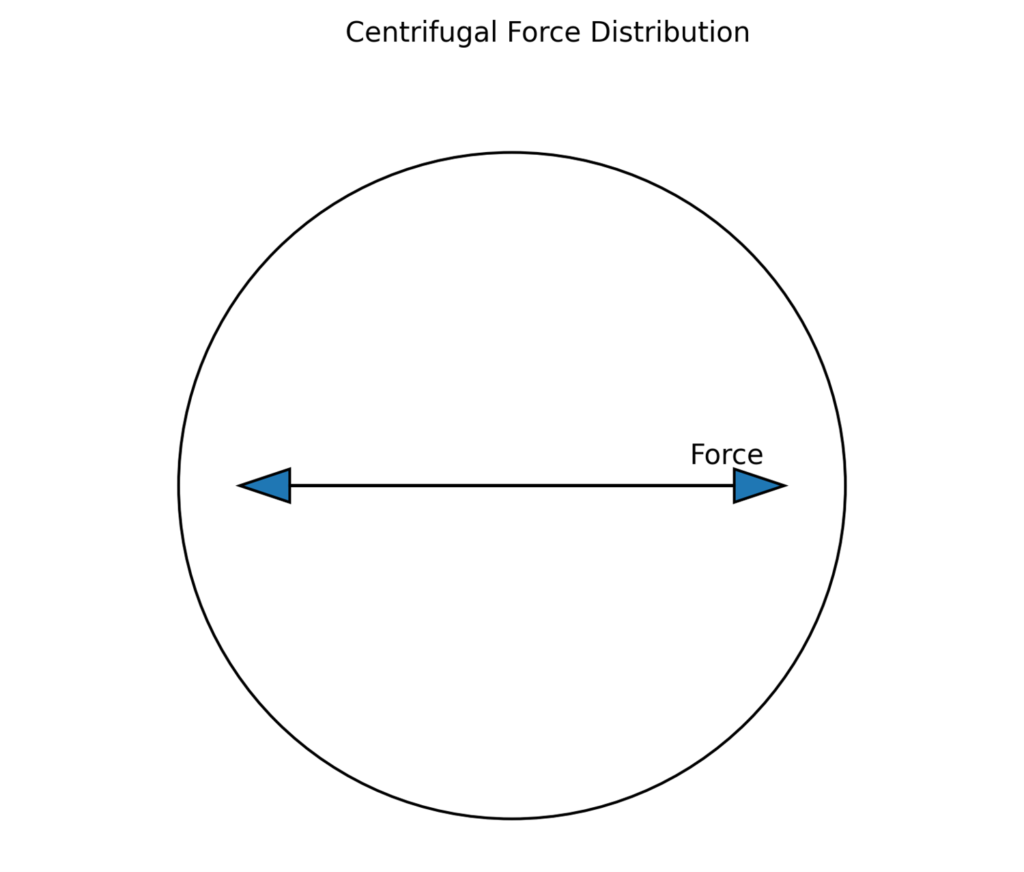
The fundamental principle behind centrifugal casting is the centrifugal force generated by rotational motion. When a mold rotates at high speed and molten metal is poured inside:
- The molten metal is forced outward toward the mold wall
- Denser metal particles move outward
- Impurities and inclusions migrate toward the inner surface
- Solidification begins at the outer mold wall and progresses inward
This directional solidification produces a dense outer layer with excellent metallurgical properties.
The process eliminates many of the defects commonly seen in static casting, such as gas porosity and shrinkage cavities.
Types of Centrifugal Casting Processes
Industrial centrifugal casting is categorized into three main methods depending on mold orientation and casting geometry.
Horizontal Centrifugal Casting
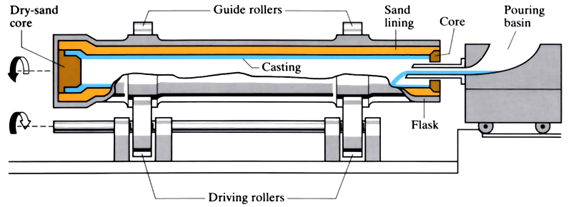
In horizontal centrifugal casting, the mold rotates around a horizontal axis. This process is widely used for producing tubes, pipes, rolls, sleeves, and reformer tubes.
Vertical Centrifugal Casting
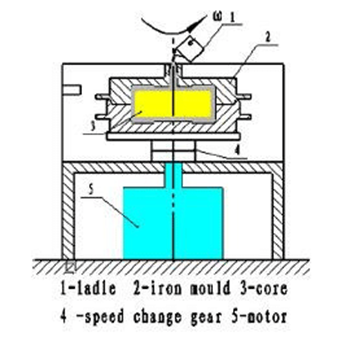
In vertical centrifugal casting, the mold rotates around a vertical axis. This method is used to produce rings, bushes, bearing cages, and valve seats.
Centrifugal Force (G-Factor)
Advantages of Centrifugal Casting
- High density metal structure
- Reduced porosity and inclusions
- Improved mechanical strength
- No core requirement for hollow components
- Efficient material utilization