
Horizontal Centrifugal Casting Process
Heavy-Duty Horizontal Centrifugal Casting Machines (HCC Series)
Introduction
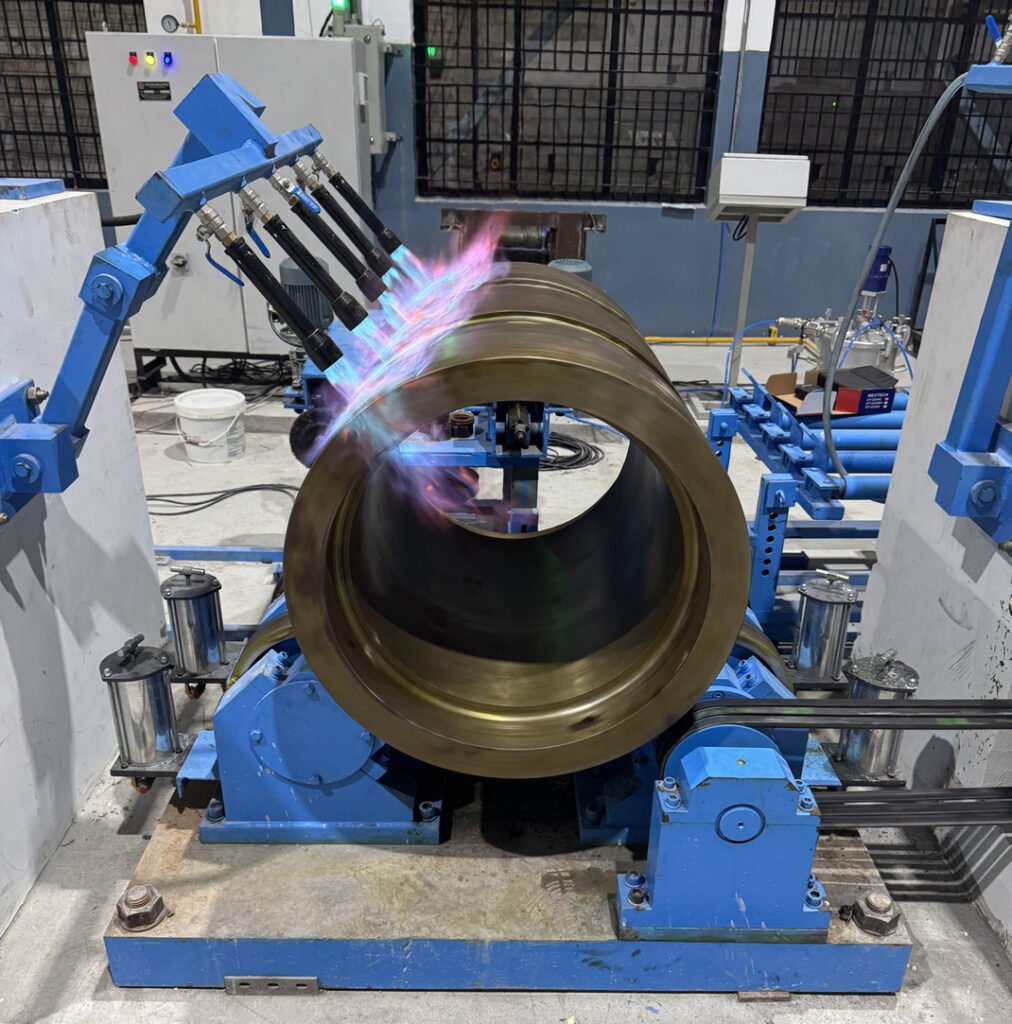
Horizontal centrifugal casting is an advanced metal casting process used for producing cylindrical components with superior metallurgical properties, high structural integrity, and excellent dimensional consistency. Gautam Industries Private Limited designs and manufactures heavy-duty Horizontal Centrifugal Casting Machines (HCC Series) engineered for continuous industrial production across global foundries.
With over 40 years of centrifugal casting expertise, we deliver robust, export-grade machines designed for large-diameter, high-speed, and high-load casting applications.
What is Horizontal Centrifugal Casting?
Horizontal centrifugal casting is a process in which molten metal is poured into a rotating horizontal mold. The centrifugal force generated during rotation distributes the molten metal uniformly along the inner wall of the mold.
Key Benefits of the Process:
- Dense outer structure
- Reduced internal porosity
- Improved mechanical properties
- Directional solidification
- Superior metallurgical quality
Process Working Principle
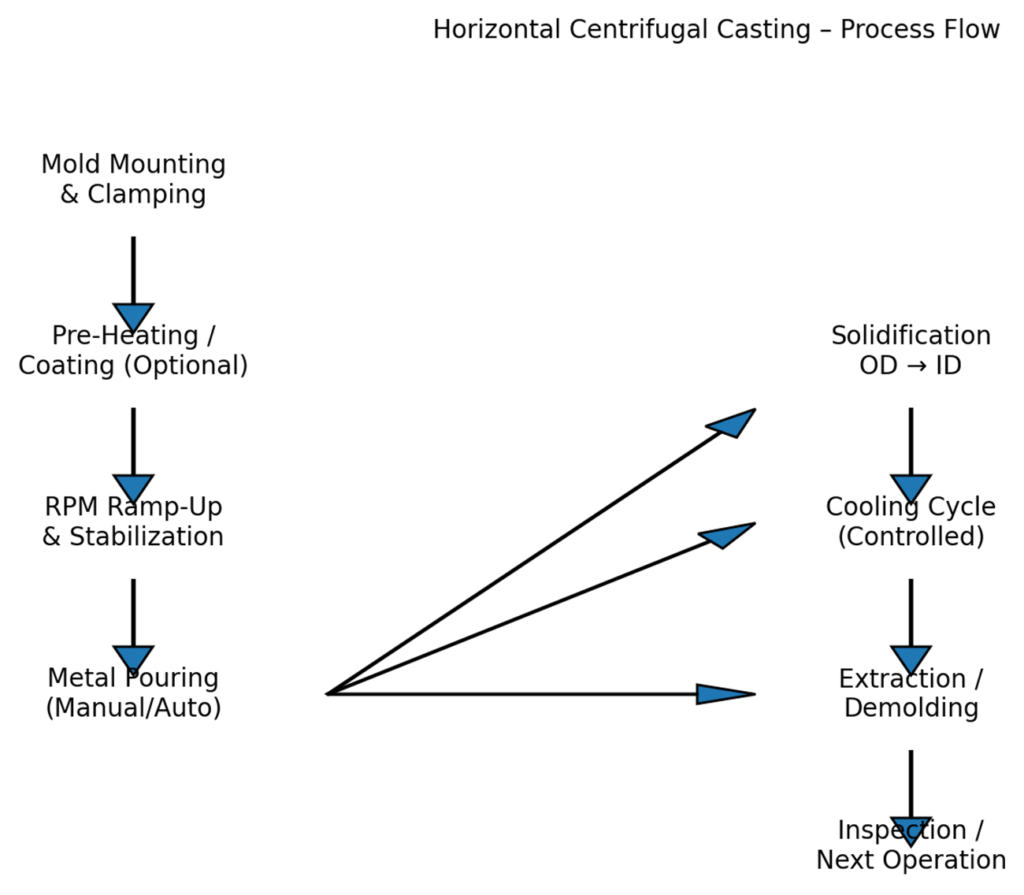
- Mold is mounted horizontally on a rotating machine spindle.
- Mold rotation begins at controlled RPM.
- Molten metal is poured into the rotating mold.
- Centrifugal force pushes molten metal outward.
- Solidification occurs from outer diameter inward.
- Impurities migrate toward inner diameter.
- Final casting achieves high density and uniform wall thickness.
Technical Diagram Explanation
This section explains the typical horizontal centrifugal casting machine layout as represented in technical diagrams.
- Base Frame: Heavy-duty fabricated structure supporting the entire system.
- Headstock & Drive System: Provides rotational motion through high-torque motor and transmission system.
- Housing Assembly: Precision-machined rotating roller holding the mold.
- Mold (Die): Cylindrical steel mold mounted horizontally for casting.
- Pouring System: Controls molten metal entry into rotating mold.
- Cooling Arrangement: External cooling system to control solidification rate.
- Control Panel: PLC or control system managing RPM, safety interlocks, and process parameters.
- Safety Guarding: Protective enclosure ensuring operator safety during high-speed rotation.
During operation, the mold rotates at a predefined RPM. Molten metal enters through the pouring system and is forced outward due to centrifugal force. Controlled cooling ensures proper grain structure and metallurgical integrity.
Advantages of Horizontal Centrifugal Casting
- Minimal gas porosity
- High-density outer surface
- Enhanced mechanical properties
- Excellent pressure resistance
- Reduced material waste
- Lower rejection rate
- High production repeatability
Applications
- Oil & Gas – Hub pipes, ring joint components
- Heat Treatment – Radiant tubes, furnace rolls
- Automotive – Cylinder liners
- Steel Industry – Rolls & sleeves
- Petrochemical – Reformer tubes
- Sponge Iron – Process tubes
- Marine – Bearing sleeves
Machine Engineering Requirements
- Rigid heavy-duty base frame
- Precision bearing arrangement
- Dynamic balancing system
- High-torque drive system
- Accurate RPM control
- Mold locking safety mechanism
- Vibration damping structure
Export-Ready Horizontal Casting Equipment
- Export-compliant electrical systems
- International safety standards
- On-site commissioning support
- Remote technical assistance
- Spare parts availability